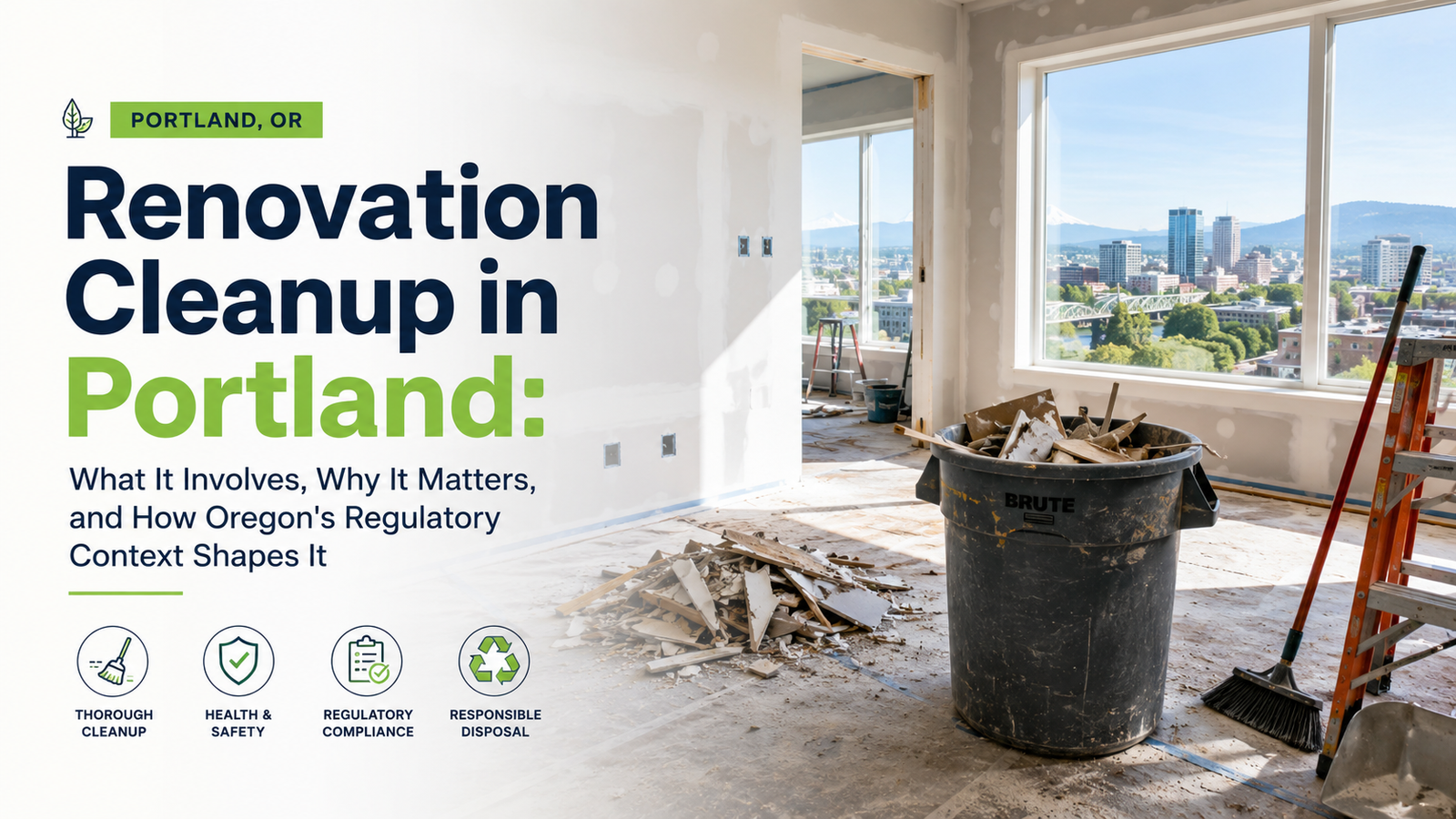
Portland’s housing stock is among the most distinctively aged in the Pacific Northwest. The city’s inner neighborhoods the Heights, Montrose, Division Street corridor, Mississippi Avenue, and dozens of other established communities throughout Multnomah County contain a significant inventory of homes and commercial buildings built in the early to mid-20th century. These properties are candidates for renovation rather than replacement in a city that values its architectural heritage and where the Deconstruction Ordinance and Historic Resources programs protect significant older structures. This active renovation culture, combined with Portland’s strong sustainability values and its comprehensive regulatory framework around construction waste, creates a distinctive context for Renovation Cleanup Portland services that differentiates Portland from many other major cities.
What Renovation Cleanup Actually Is
Renovation cleanup is the collection, sorting, removal, and proper disposal or recycling of all waste materials generated during building renovation, remodeling, and rehabilitation work. It is distinct from post-construction final cleaning (which prepares the completed space for occupancy) and from the ongoing site housekeeping that renovation crews perform as part of their daily work. Renovation cleanup specifically addresses the accumulated debris demolished building materials, packaging waste, cut-offs, and non-reusable material that builds up throughout a renovation project and must be systematically removed to keep the project moving efficiently, safely, and in compliance with applicable regulations.
Renovation cleanup in Portland encompasses a far wider range of situations than the term might initially suggest. A kitchen gut in a Bungalow Heights home generates old cabinets, countertops, tile, flooring, fixtures, and drywall debris. A bathroom renovation produces tile, vanity components, toilet, tub, and associated plumbing. A full interior renovation of a Pearl District commercial space generates the entire previous buildout walls, ceilings, flooring, mechanical systems, and finish materials. A whole-house rehabilitation project that strips a flood-damaged or fire-damaged home back to the structural frame generates everything. Each of these situations has different material volumes, different sorting requirements, and potentially different regulatory considerations.
Oregon’s Regulatory Context for Portland Renovation Debris
Portland renovation cleanup operates within one of the most comprehensive environmental regulatory frameworks for construction and demolition debris in the country. Understanding this framework is important for property owners and contractors to avoid regulatory violations and ensure that renovation debris is handled appropriately.
Oregon DEQ’s asbestos survey requirement is the most critical regulatory element for renovation projects in older Portland buildings. Under Oregon Administrative Rule Chapter 340, Division 248, residential buildings constructed before January 1, 2004 must have an asbestos survey conducted by an AHERA-accredited inspector before any demolition or renovation activities that disturb potentially asbestos-containing materials. This survey requirement is broader than the federal NESHAP standard and means that virtually any renovation of a Portland home built before 2004 may trigger the asbestos survey requirement if the scope includes disturbance of materials that could contain asbestos floor tiles, ceiling textures, pipe insulation, joint compound, roofing products, and others.
When a survey identifies regulated asbestos-containing materials, a licensed abatement contractor must remove them before renovation debris removal can proceed through standard channels. The abatement process requires Oregon DEQ notification (with a 10-working-day waiting period for projects above threshold quantities), work practices that include wet methods and HEPA filtration to prevent fiber release, and disposal at a DEQ-permitted facility with completed Asbestos Waste Shipment Report documentation.
Lead-based paint is present in virtually all Portland homes built before 1978 and many built through the 1980s. EPA’s Renovation, Repair, and Painting (RRP) Rule requires that contractors working in pre-1978 residential properties where lead-based paint may be disturbed follow lead-safe work practices containing the work area, minimizing dust spread, cleaning up thoroughly, and disposing of lead-paint-impacted debris appropriately. RRP-certified contractors are required for this work; uncertified contractors face EPA enforcement exposure.
Oregon Metro’s construction and demolition debris management framework encourages material diversion through its network of transfer stations and the regional material recovery infrastructure. Renovation debris that is source-separated wood separated from drywall from metal from concrete can be delivered to appropriate recycling channels at lower cost than mixed loads, incentivizing the on-site sorting that reduces overall renovation cleanup expense while supporting the regional diversion goals.
Renovation Cleanup Scheduling and Site Management
One of the most important principles of renovation cleanup management that professional services understand is that cleanup is an ongoing, scheduled activity not a single end-of-project event. Debris that is allowed to accumulate throughout a renovation creates cascading problems: safety hazards for the renovation crew and any occupants remaining in the building; interference with the work of subsequent trades who must navigate around piled debris; potential damage to completed work from debris contact or movement; and in Portland’s regulated environment, potential stormwater compliance issues if debris near windows or exterior access points is scattered by weather.
The most effective Portland renovation cleanup programs operate on a phase-end scheduling model: each major trade completion structural demolition complete, rough mechanical complete, drywall complete, finish work complete triggers a cleanup event that clears the accumulated debris from that phase before the next phase begins. This phase-end approach keeps the renovation site organized and productive, allows each subsequent trade to work in a clean environment, and prevents the hazardous accumulation conditions that OSHA’s construction housekeeping standards specifically address under 29 CFR 1926.25.
For renovation projects in occupied Portland homes where residents are living in portions of the building while work proceeds in others debris containment is an additional operational requirement. Plastic sheeting barriers between the work zone and occupied areas prevent dust and debris from contaminating living spaces. Debris removal pathways through the home must be planned to minimize impact on occupied areas a through-the-window chute to a dumpster below may be preferable to carrying material through occupied rooms. The physical and psychological experience of living through a renovation is significantly better when debris is consistently and promptly managed rather than allowed to accumulate and encroach on living spaces.
Material Sorting and Recycling in Portland Renovation Cleanup
Portland’s renovation cleanup market aligns with the city’s strong environmental values through active material sorting and recycling. The renovation debris stream from a typical Portland older home project includes multiple distinct materials, each with specific recycling pathways and disposal considerations.
Clean wood from renovation demolition unpainted, untreated framing lumber, flooring, and millwork has active reuse and recycling channels in Portland. The ReBuilding Center on Mississippi Avenue in North Portland is one of the most significant building material reuse organizations in the Pacific Northwest, accepting salvaged lumber, flooring, doors, windows, fixtures, cabinets, and architectural elements from Portland renovation projects for resale at reduced prices to the public. Directing usable wood material to the ReBuilding Center diverts it from landfill and provides affordable materials for lower-income Portland homeowners undertaking their own renovation projects. Old-growth Douglas fir framing and flooring from Portland’s pre-World War II housing stock is particularly valuable this material, harvested from old-growth timber that cannot be replicated today, has both mechanical properties and character that new-growth lumber cannot match.
Metal from renovation debris plumbing copper and galvanized steel, electrical wire, HVAC components, structural steel, and miscellaneous metal has recycling value through Portland’s active scrap metal market. Professional renovation cleanup services separate and recycle metal as a standard practice, recovering material value that offsets the overall cleanup cost.
Gypsum drywall from renovation projects has specific recycling pathways in the Portland area for clean, unpainted material. Oregon has been developing its gypsum recycling infrastructure, and clean drywall scrap from new installation in renovation projects can sometimes be directed to recycling rather than landfill. However, painted, textured, or contaminated drywall from demolition work typically goes to landfill under current regional acceptance criteria.
Common Questions About Renovation Cleanup in Portland
Does Oregon’s asbestos survey requirement apply to my Portland home renovation? Yes, if the home was built before January 1, 2004 and the renovation scope will disturb materials that could contain asbestos. Oregon’s requirement is broader than the federal standard it applies to all residential buildings built before 2004, not just those built before 1981. A pre-renovation asbestos survey by an AHERA-accredited inspector confirms whether regulated materials are present and informs the demolition and cleanup approach.
Can renovation debris in Portland be donated rather than disposed of? Yes, and this is encouraged. Portland’s ReBuilding Center, Habitat for Humanity’s ReStore program, and other organizations accept usable building materials including lumber, flooring, doors, windows, cabinets, plumbing fixtures, and lighting. Donating usable materials diverts them from landfill and may provide tax-deductible contribution value for the property owner. Renovation cleanup services that incorporate donation assessment and delivery provide this benefit as part of their scope.
What containers are used for Portland renovation debris removal? Roll-off dumpsters in sizes from 10 to 40 cubic yards are the standard container for renovation debris in Portland. Container placement requires adequate truck access and, for containers placed on public streets, a right-of-way permit from the City of Portland. Source-separated containers for specific material types (clean wood, metal, drywall) can reduce disposal costs compared to mixed-load containers.